Put a Quest on in 2022 and Horizon Worlds was hard to miss. It sat in your feed, in your store, in the pitch for why you bought the headset at all.
A flagship that never filled up
Horizon Worlds launched on December 9, 2021 in the U.S. and Canada. It was a multiplayer world and a creation system at once — you showed up as an avatar, wandered into spaces other people had built, and could build your own.
The numbers came fast, then stalled. Meta reported an estimated 300,000 users in February 2022. By October 2022, reporting cited in the same record put monthly users below 200,000. Most visitors, internal documents reported at the time said, did not return after the first month.
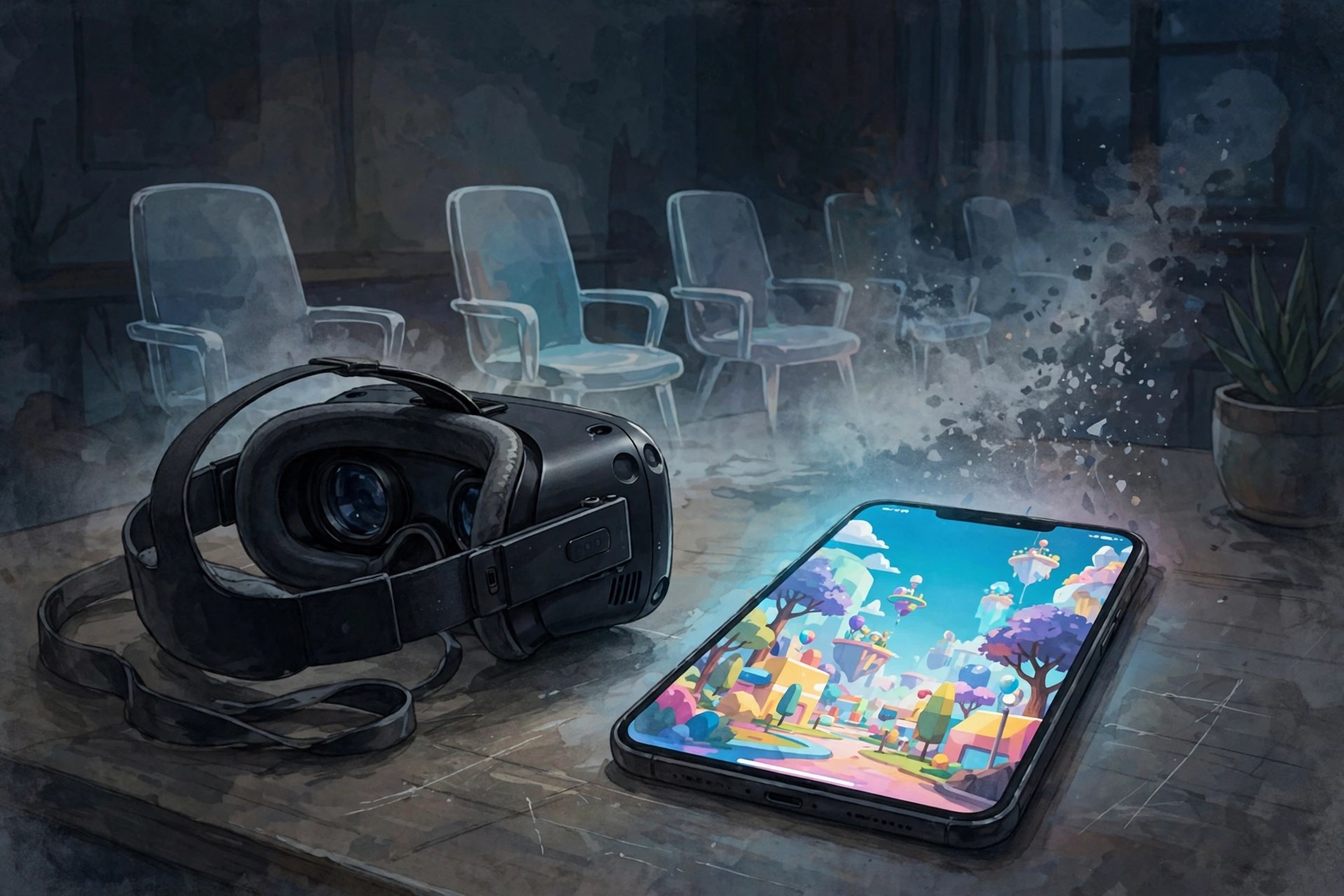
A mobile version arrived in September 2023. If people would not come to a headset, maybe a phone screen would do.
February was the real turn
In February 2026 Meta announced it would separate Worlds from the Quest VR platform and focus primarily on the mobile version. Pocket Gamer’s summary of that announcement puts the logic plainly: scale through mobile rather than niche VR social adoption, while Reality Labs cut spending and kept backing VR hardware itself.
Hardware stays. Meta’s own social world on that hardware does not get the same commitment.
March gave it dates
Road to VR reported that on March 31, Horizon Worlds and Events would no longer appear in the Store on Quest. The removal was said to include Horizon Central, Events Arena, Kaiju and Bobber Bay from Quest access.
Hyperscape went earlier. Spatial captures were to be removed from Worlds on March 24. Existing captures would stay viewable in the Hyperscape Capture (Beta) app, Meta said, but sharing, inviting people in and co-experiencing them would no longer be supported.
Then came the hard date: June 15. Meta would remove the Horizon Worlds app entirely from Quest, and worlds would no longer be available in VR in any capacity after that date.
Road to VR also placed this next to two other facts. Meta had shuttered Horizon Workrooms, its work-focused immersive platform, the month before. Reality Labs had recently seen layoffs affecting 10 percent of the XR division, plus the closure of three first-party XR studios.
Then Meta blinked — a little
Road to VR updated its March report on March 19: some experiences would still be accessible on Quest after all, specifically those based on the Unity game engine and not the new in-house Horizon Engine. The Horizon Worlds record summarises the same reversal this way: Meta planned to support existing games for the foreseeable future, but no new games would be added to the VR version.
That distinction matters. Existing Unity-based worlds: still playable in VR, for now. New development energy, new games, the new engine: mobile.
If you built in Worlds early, your room did not vanish on June 15. If you were deciding in 2026 where to build next, Meta had already answered. Build for the phone version, or build somewhere else.
A platform can be technically alive and commercially dead at the same time. No storefront push. No new games arriving to bring fresh visitors past your door. Support without growth is a waiting room.
Where people actually go
Social VR did not end when Meta stepped back. People moved, as they have moved before.
A guest piece in Road to VR on closed virtual worlds notes that VRChat recently invited displaced users from Rec Room and Horizon Worlds to come over. Rec Room itself shut down on June 1, 2026 at noon Pacific, after connecting more than 150 million players and creators, according to that piece.
The older example still works as a warning and a hope. Microsoft shut AltspaceVR on March 10, 2023. Former users organised in VRChat, rebuilt spaces inspired by the ones they lost, and held a week-long memorial marking three years since the shutdown. VRChat, the piece says, hit a new all-time high of nearly 158,000 concurrent players earlier that month.
Horizon sits between those outcomes. The mobile version lives. Some VR worlds live. The original idea — Meta’s headset, Meta’s avatar, Meta’s world, all one seamless place — does not.
If Worlds was your place
Check which version your world runs on before you plan anything. Unity-based existing games got the reprieve. Horizon Engine work belongs to the mobile future Meta described.
Take your community somewhere you control the contact list. A Discord, a VRChat group, a list you own — anything that survives if an app icon disappears from a store.
Your Quest did not lose VR this year. It lost the illusion that Meta would keep its own biggest social bet inside the headset forever. Third-party worlds still fill up on a Friday night. Just do not build your home on land where the owner has already posted the new plans — and the new plans are for phones.
Sources
- Road to VR (18 March 2026, updated 24 April 2026) — Meta is Permanently Shuttering the VR Version of ‘Horizon Worlds’ in June
- PocketGamer.biz (18 March 2026) — Meta pulls Horizon Worlds from VR as platform shifts to mobile
- Wikipedia — Horizon Worlds
- Road to VR, guest article by Julian Reyes (29 May 2026) — As Virtual Worlds Close, Communities in ‘Rec Room’, Meta’s ‘Horizon Worlds’, and Others Create Ways to Survive